


Criminal Report on the Chinese-Cambodian Crime Syndicate “Prince Group”


(Based on the indictment and forfeiture complaint submitted by the U.S. Attorney’s Office for the Eastern District of New York on October 14, 2025, titled United States v. Approximately 127,271 Bitcoin)
I. Case Overview
On October 14, 2025, the U.S. Attorney’s Office for the Eastern District of New York designated Chinese businessman Chen Zhi (alias Vincent) and his conglomerate Prince Holding Group, based in Cambodia, as a Transnational Criminal Organization (TCO) and filed a civil forfeiture action to seize approximately 127,271 Bitcoin (BTC) — then valued at about $8.5 billion USD (₩11 trillion KRW) — as criminal proceeds.
Chen holds multiple nationalities — China, Cambodia, Vanuatu, Saint Lucia, and Cyprus — and has operated across Singapore, the United Kingdom, and Taiwan. The U.S. government alleges that he used Prince Group as a fronted corporate empire functioning as a criminal conglomerate, engaging in:
Worldwide cryptocurrency investment fraud,
Forced labor, human trafficking, and unlawful confinement,
Money laundering and foreign bribery,
yielding illicit profits worth billions of dollars.
II. Structure and Operations of the Criminal Organization
Prince Holding Group
Ostensibly presented as a real-estate, finance, hospitality, and banking conglomerate.
In reality, it operated “Pig-butchering”–style cryptocurrency investment scams using forced-labor cyber-fraud compounds.
Victims span more than 70 countries across the United States, Europe, and Asia.

Systematic Forced Labor and Confinement
Operated at least ten scam compounds throughout Cambodia.
Trafficked young people were detained and forced to send fraudulent investment messages and social-media solicitations.
Major facilities included:
Jinbei Hotel Compound — Sihanoukville
Golden Fortune Technology Park — Kraiteum
Mango Park — Kampong Speu
Key Figures
Chen Zhi (Vincent) — Chairman of Prince Group; architect of the entire fraud system.
Co-conspirators 1–7 — Senior executives of various nationalities managing real-estate, banking, cryptocurrency exchanges, and mining operations.
Affiliated entities: Prince Bank, Awesome Global Investment Group, Warp Data (Laos), Lubian Mining (China & Iran), Amber Hill Ventures (BVI), among others.
III. Major Criminal Activities
Cryptocurrency Fraud (“Pig-butchering Scam”)
Victims lured through fake investment apps or chats → shown fabricated profits → induced to invest more → withdrawals blocked → operators vanished.
The Brooklyn Network branch defrauded about 250 U.S. citizens of $18 million USD.
Funds were funneled through shell accounts in New York and Queens before reaching Prince Group.
Money Laundering
Used professional laundering networks (“Money Houses”) and internal subsidiaries for BTC cleansing.
Mining firms such as Warp Data and Lubian Mining were disguised as “legitimate revenue sources.”
Applied a “Spraying & Funneling” technique — dispersing assets across thousands of wallets, then reconsolidating to obscure traceability.
Portions of proceeds purchased Picasso paintings, yachts, luxury goods, and bribes to foreign officials.
International Corruption and Violence
Bribes paid to officials in China’s Ministry of Public Security (MPS) and Ministry of State Security (MSS).
Secured prior notice of law-enforcement actions and colluded with local police.
Multiple internal cases of assault, kidnapping, and retaliation against whistle-blowers.
IV. Asset Forfeiture and Sanctions
Assets Subject to Forfeiture
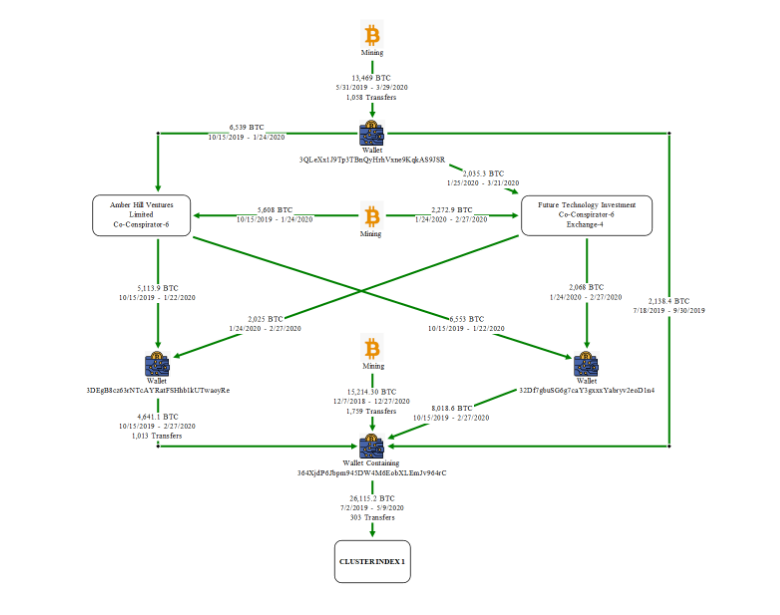
127,271 BTC spread across 25 cryptocurrency wallets.
FBI analysis confirmed that most funds flowed through fraudulent, mining, and laundering chains back to Chen Zhi’s personal wallets.
The wallets are now under federal custody.
Sanctions
October 14 2025: The U.S. Treasury Department’s Office of Foreign Assets Control (OFAC) added Prince Group Transnational Criminal Organization (TCO) to the Specially Designated Nationals (SDN) list.
All U.S.-based assets frozen; any transaction with U.S. persons or institutions prohibited.
V. Legal Proceedings
Criminal Indictment: On October 8 2025, a grand jury in the Eastern District of New York indicted Chen Zhi for:
Conspiracy to Commit Wire Fraud (18 U.S.C. § 1349)
Conspiracy to Commit Money Laundering (18 U.S.C. § 1956(h))
Civil Forfeiture Complaint: Filed October 14 2025, seeking seizure of 127,271 Bitcoin as criminal proceeds.
VI. Conclusion and Outlook
The Prince Group case represents the largest cyber-financial crime network in Asia.It transcends ordinary fraud, revealing:
The criminalization of Chinese transnational capital,
Institutional corruption across Cambodia and Southeast Asia, and
A globalized cryptocurrency-laundering system.
The U.S. government’s prosecution is not merely law enforcement but a strategic countermeasure against the rise of a Chinese transnational shadow-finance network operating through digital systems worldwide.
VII. Organizational Chart of the Prince Group Criminal Network
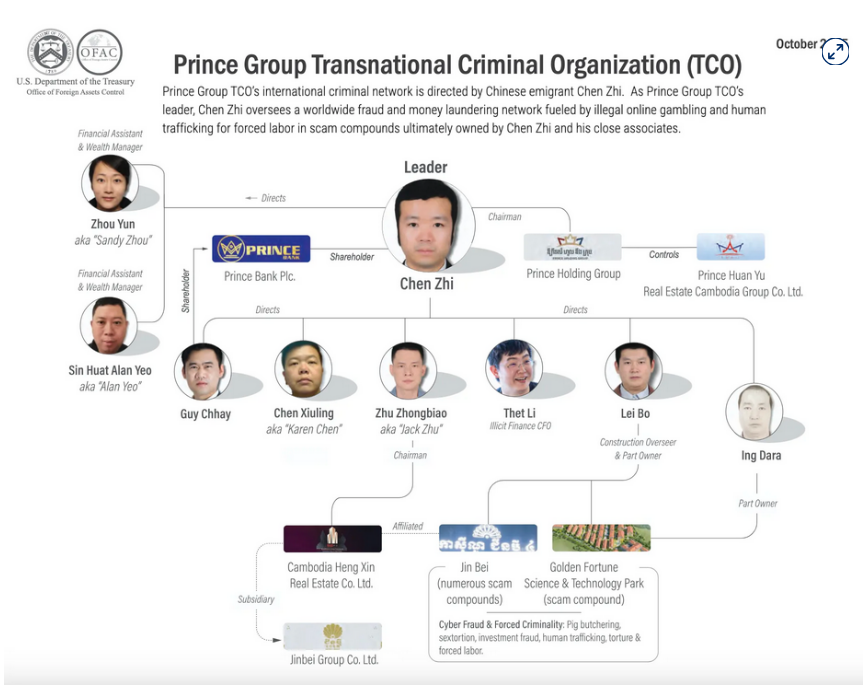
1. Central Command
Chen Zhi (“Vincent”) — Chairman and ultimate controller of Prince Group.
Multinational citizen (China, Cambodia, Vanuatu, Saint Lucia, Cyprus).
Directly supervised capital flows, mining networks, and diplomatic ties.
Principal target of OFAC sanctions.
Co-Conspirators 1–7 — CEOs and financial chiefs of various affiliates managing laundering, bribery, violence, and online scams.
2. Core Business & Laundering Pillars
Sector | Entity | Function | Jurisdiction |
Real Estate | Prince Real Estate / Huan Yu Group | Front for legitimate business façade | Cambodia |
Finance | Prince Bank | Money-laundering hub | Cambodia |
Investment | Awesome Global Investment Group | Casinos, property, entertainment façade | Singapore |
Technology | Warp Data Technology Lao Sole Co., Ltd. | BTC mining facility | Laos & Texas |
Mining | Lubian Mining | China / Iran operations; BTC laundering route | China |
Offshore Laundering | Amber Hill Ventures, FTI, LBG | BVI & Cayman shell companies | Tax havens |
3. Field Operations
Scam Compounds (Forced-Labor Centers)
Operated across Cambodia; thousands of trafficked victims forced into scam labor.
Internal documents label each building by target market (“China segment,” “U.S. segment”).
Brooklyn Network
Utilized bank accounts in New York & Queens.
Over 250 U.S. victims; $18 million stolen via fake trading app “Trading Platform-1.”
VIII. U.S. Victim Case Summary
Victim-1 (California resident)
Contacted by fake “investment expert” via SNS; sent $400,000 USDT.
Funds traced through 0x1e → 0x83 → 0x34 → 0x77 addresses; FBI linked final wallet cluster to Chen Zhi.
Brooklyn & Queens Group of 250 Victims
Defrauded $18 million USD through fake FX platforms.
Victims were told to pay “taxes” to withdraw balances.
FBI investigation (summer 2022 – 2025) led to the current forfeiture action.
IX. Links to the Chinese Government
MPS / MSS Collusion
In May 2023, a co-conspirator bribed an MPS official for advance notice of crackdowns.
MSS contacts promised pre-raid warnings.
Internal minutes recorded “coordination with MPS & MSS completed.”
Diplomatic Cover & Passport
In 2020, Chen gifted a $3 million yacht to a foreign official to obtain a diplomatic passport, which enabled his U.S. entry in April 2023.
Chinese Financial Pipeline
Laundered thousands of BTC through Exchange-1 (China).
Chinese authorities refused U.S. legal assistance, leading DOJ to label Exchange-1 “a hub for laundering by foreign criminals.”
X. Geopolitical Significance
This case exposes how Chinese capital integrates crime, technology, politics, and diplomacy into a single transnational control system.The Prince Group is a new imperial hybrid where state power and criminal capital interlock, forming a global war-economy model via cryptocurrency ecosystems.
The U.S. has classified the group as a national-security threat, sanctioning it as a complex of terrorism, trafficking, and cybercrime, marking the first tangible blow against the Chinese global financial shadow network.
XI. The Prince Group Case as a New Model of Unrestricted Warfare
1. Fundamental Principle of Unrestricted Warfare
In 1999, PLA Colonels Qiao Liang and Wang Xiang-sui wrote Unrestricted Warfare, declaring that“the boundaries of war have disappeared; finance, networks, trade, media, law, and crime are all parts of the battlefield.”Its core axiom: “If you can destroy a nation without firing a shot, that is the highest form of war.”
Chen Zhi’s Prince Group embodies this doctrine in practice — a digital militia-style war economy combining corporations, fraud, cryptocurrency, and human trafficking.
2. Operational Means: Extracting Foreign Currency Through Crime
Prince Group operated across Cambodia, Laos, Myanmar, and Iran, conducting Pig-butchering scams that siphoned vast sums of USD and crypto from the West.This structure functioned as a form of state-sanctioned or state-tolerated economic warfare.
Trafficking, fraud, mining, and laundering operated under one command chain.
Victims were primarily citizens of the U.S. and Europe.
Stolen crypto flowed into Chinese Exchange-1 → converted to yuan, gold, and real assets.
This “Reverse Dollar Flow” eroded the Western financial system from within.
3. Diplomatic Shield
Chen Zhi bribed officials from MPS and MSS to obtain advance intel on raids.This was not mere personal corruption but an institutional symbiosis — a State–Crime Hybrid typical of Unrestricted Warfare.
His diplomatic passport was a state-level immunity mechanism for covert operations.
Even if Beijing denies involvement, the evidence shows an entrenched coexistence between official power and illicit networks.
4. The Cyber-Financial-Trafficking Complex: A “Grey-Zone War”
Prince Group disabled nations’ economies and human-rights systems without deploying military force.A hybrid criminal-strategic system that:
Penetrated U.S. financial markets via cryptocurrency,
Sustained cheap fraud labor through trafficking and forced work,
Neutralized sanctions through bribes and diplomatic protection.
These fit the PLA concept of asymmetric dominance, proving Prince Group to be not just a crime syndicate but a Chinese experimental war economy model.
XII. Exposure Across East Asia
1. Cambodia — China’s “Economic Colony Forward Base”
Since the 2010s, Chinese capital has entered Cambodia under real-estate investment pretexts.
Prince Group turned Sihanoukville into a “scam industrial zone.”
Local officials and police were tied to Chinese investment, making control virtually impossible.
2. Laos & Myanmar — Mining and Manpower Bases
Warp Data in Laos connected laundering lines to Texas, USA.
Northern Myanmar hosts multiple illegal “power-theft” mining sites.
Collaboration between Chinese firms and local warlords created a semi-official criminal economy.
3. U.S. Countermeasures and Future Spread
FBI, Treasury, and DOJ achieved the first major coordinated crypto forfeiture.
U.S. Congress is considering the Digital Fraud and Trafficking Sanctions Act (DFTSA).
Yet, as long as off-grid platforms like Exchange-1 exist, the model may expand through Southeast Asia and Africa.
XIII. Conclusion — The Essence of the “Prince Model”
Chen Zhi and Prince Group represent the operational prototype of digital Unrestricted Warfare.Their goal was not merely profit but the systemic erosion of Western finance, rule of law, and human rights from within.
The case demonstrates that China’s Unrestricted Warfare doctrine has already materialized across economic, financial, digital, criminal, and diplomatic fronts.Thus, the Prince Group case can be defined as “the invisible opening of World War III.”

Comments